top of page


If You Don’t Snooze, You Lose
Sleep-deprived Singaporean youths are finding the silver lining to their predicament during home-based learning.
By Amanda Tay and Phylicia Law

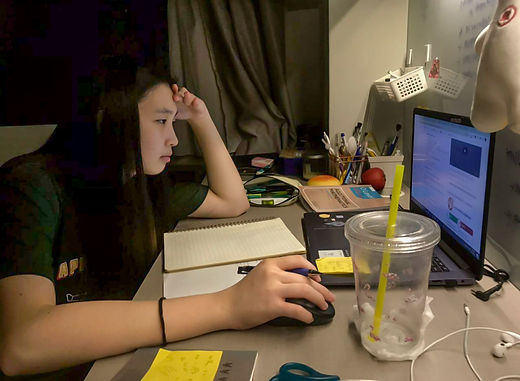
Rachel Ng, 18, staying up late into the night to finish her class assignment. Photo: Amanda Tay
The coronavirus has served as a break in the clouds to youths’ sleep deprivation after it brought schools online and had lesson plans shifted to home-based learning (HBL).
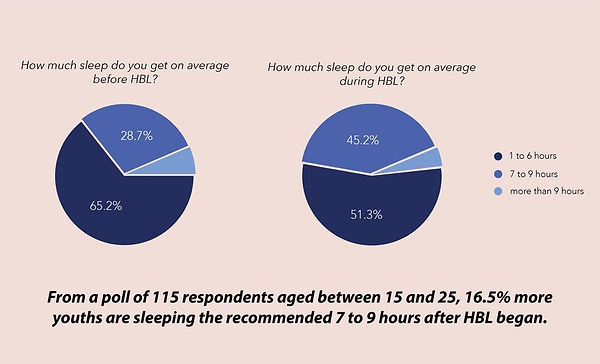
EXCLA!M conducted a poll with 115 respondents aged between 15 and 25 and found that although they were still getting insufficient sleep, the number of youths acquiring the National Sleep Foundation’s recommendation of seven to nine hours of sleep daily has increased by 16.5 per cent since HBL commenced.

Rachel Goh, 18, student of Millennia Institute, has been suffering from insomnia since she was in Secondary 3. With the “stress from workload in school especially during exam periods”, Goh only manages to get five hours of sleep on weekdays, which fall below the recommended amount for youths aged 18 to 25.
Her sleep deprivation causes her to get frustrated and stressed more easily, affecting her academics. “I get very exhausted the following day and [will not be able] to focus well during lessons. I also have a shorter attention span when I revise and have to take frequent breaks in between to focus better,” says Goh.
Rachel Ng, 18, a Pharmaceutical Science student at Temasek Polytechnic, shares the same sentiments as Goh. “Sleeping less than 8 hours a day has caused me to be more lethargic and tired during the day,” says Ng, who only gets about four to six hours of sleep an average school night.
Insufficient sleep causes her to doze off during classes, adversely affecting her learning. “I am always missing out [on] the content taught during lectures. So during exam season[s], I [will] have to put in the extra mile to be on par with my classmates, which has taken a toll on me mentally,” says Ng.
Goh and Ng are not the only ones suffering from the lack of sleep. The same poll EXCLA!M carried out found that 65.2 per cent of youths surveyed got between one and six hours of sleep on average before HBL started, which brought about implications to their health and emotions.
Dr Stjin Agus Adrianus Massar, a Cognitive Neuroscientist, urges youths to obtain more sleep. “Cutting your sleep for a couple hours everyday negatively impacts your attention and learning abilities,” he says.
“Sleep deprivation has a negative impact on the functioning of the emotional regulation circuit of the brain. [This] means that a teenager who gets less shuteye will be more likely to have extreme emotional responses to daily events,” says Dr Kamini Rajaratnam, a Holistic Psychiatrist at Better Health Psychological Medicine Clinic.
Set a bedtime for yourself that will allow enough time to sleep – and keep as close to it as you can

- Dr Rajaratnam
However, Goh expresses that HBL has allowed her to sleep more and has improved her sleep quality. “I’ll plan out my week's schedule [for] revision and homework so I'll be able to get some rest in between. This helps manage my sleeping time,” she says.
Ng also feels that her sleep has gotten better during HBL. Prior to HBL, Ng spent up to two hours on her daily commutes to school. But now, she says “as lessons are now conducted at home, I do not have to travel to and from school, which allows me to get more sleep before and after classes”.
Dr Massar thinks that having more time and flexibility in their schedules could also be reasons why youths are dedicating more time to sleeping, and Dr Rajaratnam agrees. She says, “Generally, working and studying from home has freed up time spent during the commute and makes it more accessible to have a good timetable and plan regular sleep and waking times.”
To advise youths to get more sleep after home-based learning subsides, Dr Rajaratnam suggests creating a schedule for sleep and sticking to it. “Set a bedtime for yourself that will allow enough time to sleep – and keep as close to it as you can,” she says.
Dr Massar concurs with her. “There will always be a case where there’s more work to do,” he says. “Eventually it all comes down to scheduling.”
21 August 2020
About the Authors

Amanda Tay
Amanda swears by her cup of tea either before early lectures or tutorial classes to start her day right.

Phylicia Law
Phylicia is a passionate writer who loves learning more about others and sharing their stories. She actively seeks out new story ideas and is always excited to share them with the world.
bottom of page